Print-on-Demand vs. Bulk Apparel Manufacturing: What Growing Brands Should Choose
This might be one of our most common questions. It seems like almost every day new and established brands are trying to determine the best option regarding quality, margin and scalability.
For a growing apparel brand, the transition from side project to market player is defined by one critical decision: how you actually make your products. You’ve likely started with Print-on-Demand (POD) because it’s easy. But as your order volume climbs, you start to notice the cracks: thin margins, inconsistent print quality, and generic packaging.
At Superior Ink, we see this inflection point every day. Brands reach a ceiling where the low-risk nature of POD becomes a high-cost anchor. This guide breaks down the print on demand vs bulk printing debate, focusing on the unit economics, quality control, and scalability you need to reach the next level. This is a non biased option that we hope will help educatute your decision on which is the best option for your brand.
1. Print on Demand vs. Bulk Printing: The Direct Comparison
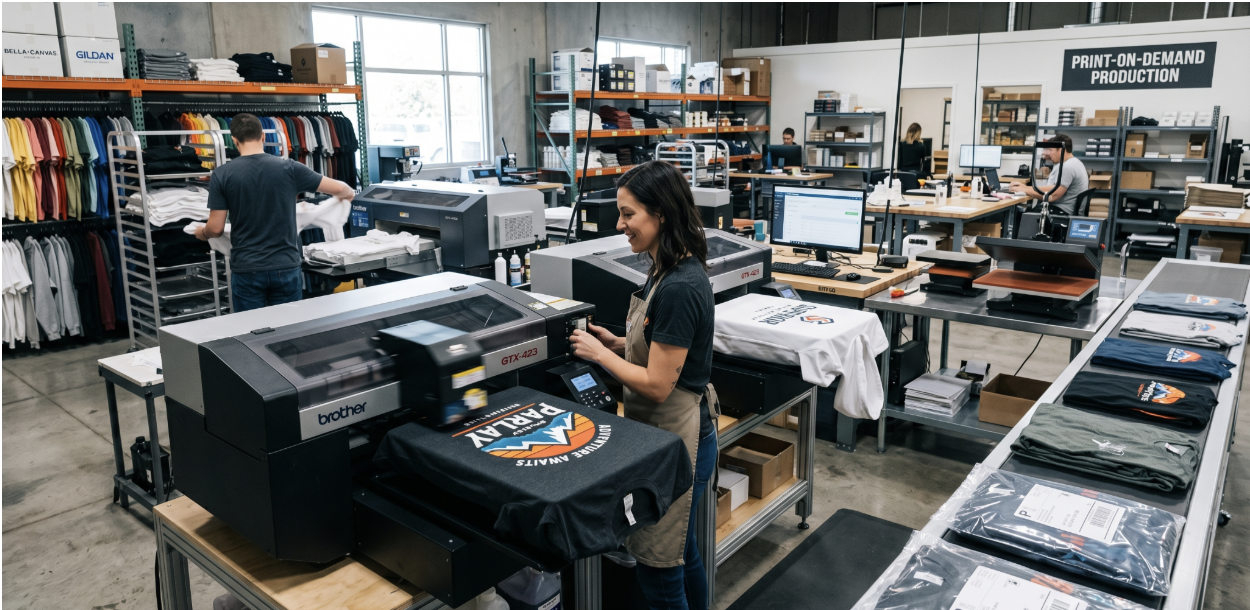
The Quick Answer: Print-on-Demand (POD) is a fulfillment model where items are printed only after a sale is made. Bulk printing is a manufacturing model where garments are produced in large quantities (usually 50+ units) upfront and stored for future sale.
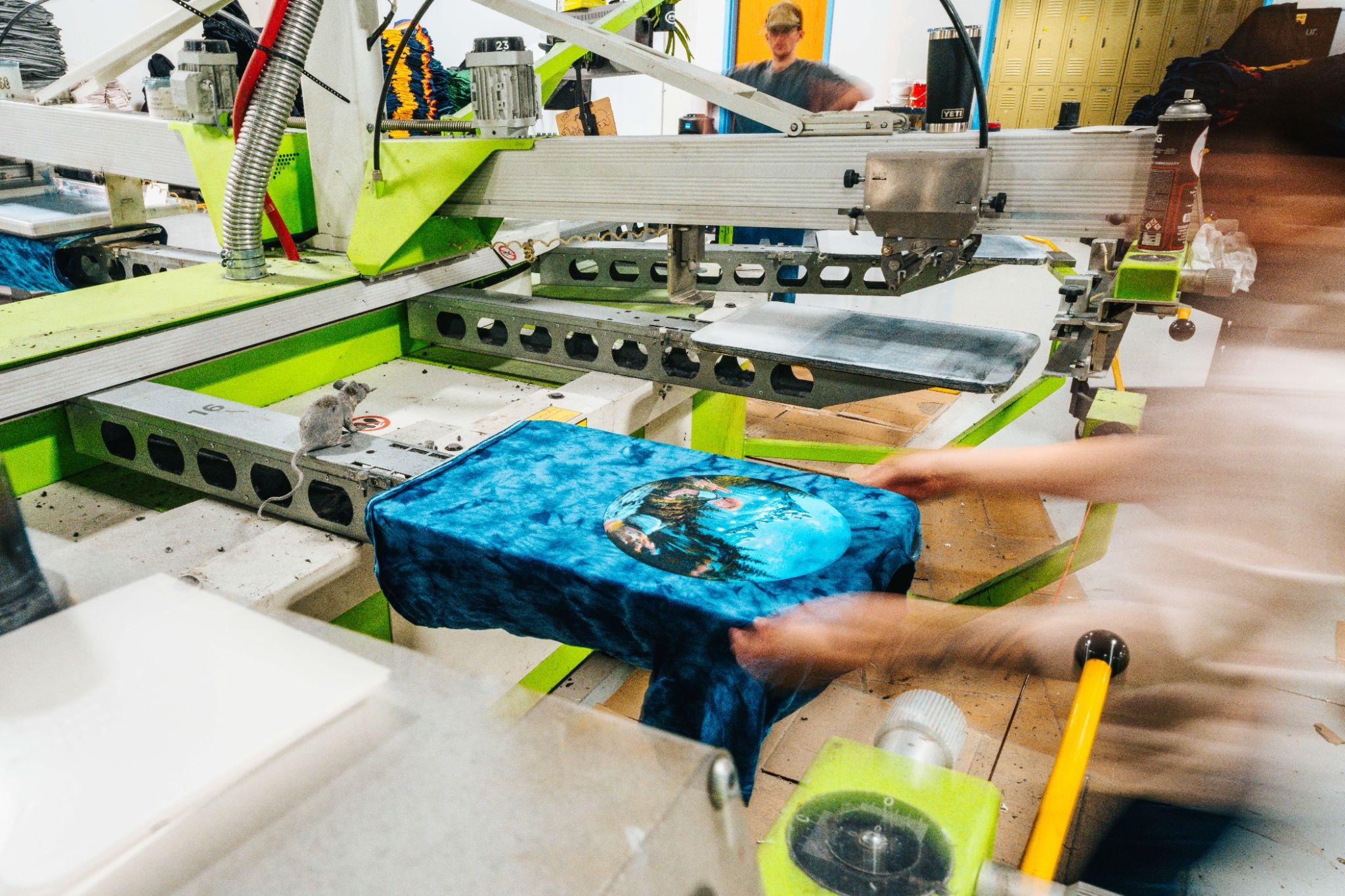
While POD is excellent for testing concepts without financial risk, bulk printing is the industry standard for brands that prioritize high profit margins, premium retail quality, and custom branding (like woven labels and unique ink finishes).
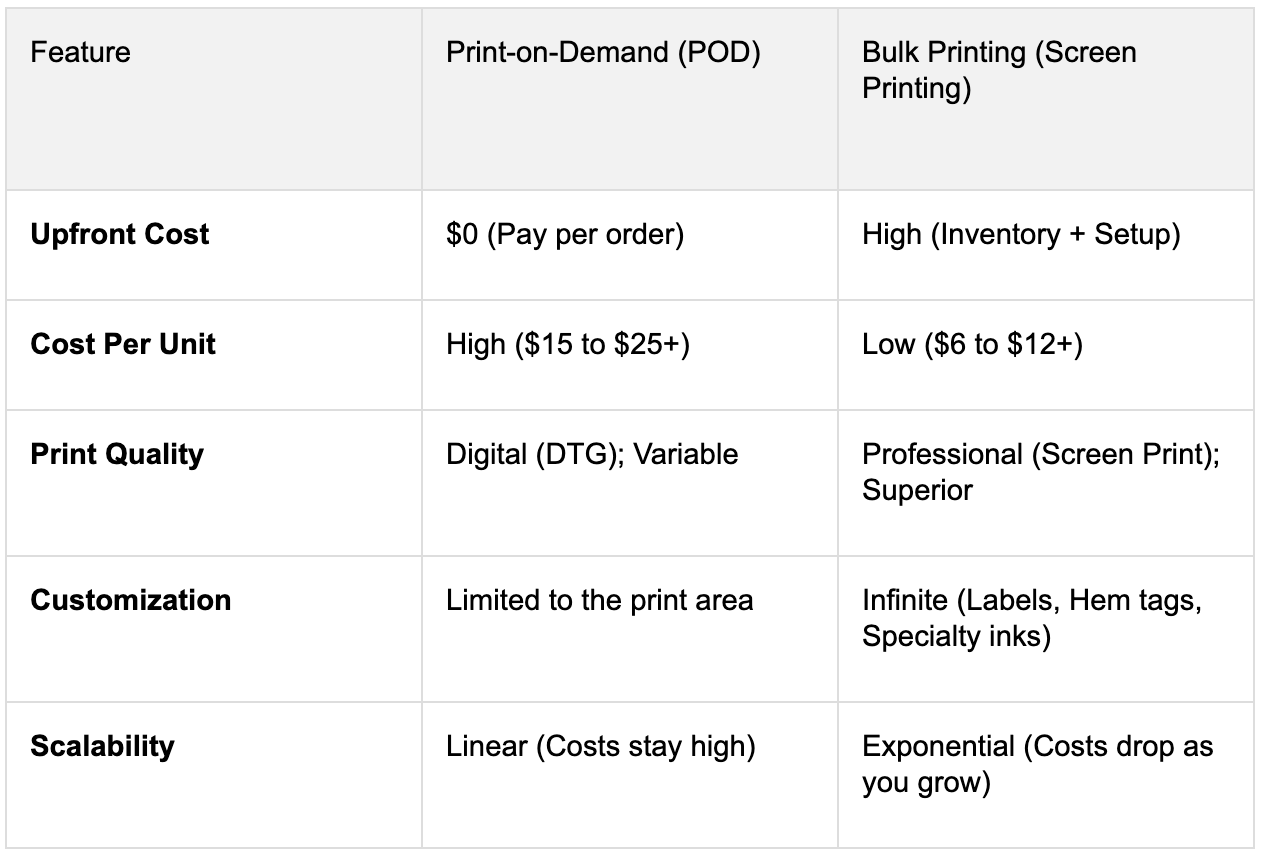
At a Glance: Key Differences
2. Print-on-Demand vs. Bulk Printing Cost Comparison
The Bottom Line: POD has a lower barrier to entry but a much higher ceiling cost. Bulk printing requires an initial investment but drastically increases your gross margin per shirt.
When comparing print-on-demand vs. bulk printingcosts, you have to look past the setup fee. In the world of POD, you are essentially renting the printer's time and logistics at a premium.
The Margin Gap
Let’s look at a standard retail t-shirt selling for $30:
POD Scenario: You pay $22 for the shirt and printing, plus $5 for fulfillment. Your profit is $3.
Bulk Scenario: You order 100 shirts at $12 each. Even with a $3 per-shirt fulfillment fee through a 3PL partner, your cost is $15. Your profit is $15.
Real-World Insight: For a brand moving 200 shirts a month, switching to bulk can put an extra $2,500+ back into your pocket every single month. That is the capital you need for ads, new designs, or photography.
3. Print on Demand vs. Bulk Printing Pros and Cons
Every production method has trade-offs. To choose correctly, you must decide whether you are optimizing for convenience or brand equity.
Print-on-Demand (POD)
Pros: No dead stock (unsold inventory), no warehouse needs, and the ability to test 50 designs at once.
Cons:Low profit margins, limited garment choices, and inconsistent colors. Because POD uses digital printers (DTG), the same design might look different if it’s printed in different facilities. It's also a process that doesnt have the same feel or resolution as screen printing. Screen printing is sharper and more crisp and can print on an array of different fabrics.
Bulk Printing (Screen Printing)
Pros:High profit margins, absolute color consistency (Pantone matching), and access to premium techniques like discharge or high-density inks. You also control the unboxing experience.
Cons: Requires upfront capital and a place to store the gear unless you use an integrated partner like Superior Ink.
Let's Build Something
Your Brand Is Proud Of
Your end-to-end merch partner, helping your brand scale sustainably without compromising quality.
4. The Quality Divide: DTG vs. Professional Screen Printing
In a print-on-demand vs bulk printing evaluation, quality isn't just a buzzword: it’s the difference between a one-time buyer and a lifetime fan.
The Feel of the Ink
Most POD services use Direct-to-Garment (DTG). It’s essentially an inkjet printer for fabric. While it handles gradients well, it often lacks the punch of traditional printing and can feel like a plastic sticker on the shirt.
At Superior Ink, we specialize in Bulk Screen Printing, offering advanced ink chemistry:
Plastisol Inks: The industry standard. Vibrant, durable, and opaque.
Discharge Inks: A soft hand technique that dyes the fabric fibers themselves. It removes the garment's original color and replaces it with your ink, resulting in a print you literally cannot feel.
Water-Based Inks: Eco-friendly and ultra-breathable, perfect for high-end retail brands.
5. When to Make the Switch: The Rule of 50
How do you know it’s time to move away from POD? We recommend the Rule of 50.
If you have a design that consistently sells 50 units or more per month, you are losing significant money by staying with POD. Moving that specific hero product to a bulk run at Superior Ink allows you to lower your COGS immediately, improve quality, and utilize 3PL fulfillment to keep shipping hands-off while maintaining custom packaging.
6. How Does the 3PL Model Solve the Bulk Printing Storage Problem?
The biggest deterrent for brands moving to bulk is the "garage full of boxes" syndrome. A Third-Party Logistics (3PL) provider eliminates this by acting as your off-site warehouse and fulfillment team.
Scalable Infrastructure: Instead of paying for a fixed warehouse lease, you pay for the pallet space you use.
Integrated Inventory Management: Most 3PLs sync directly with Shopify or WooCommerce. When a bulk order arrives at the warehouse from the printer, it’s digitized, tracked, and ready for auto-fulfillment.
Reduced Shipping Costs: 3PLs leverage massive shipping volumes to get discounted rates from carriers (UPS, FedEx, USPS) that small POD brands simply can't access.
Professional Unboxing: Unlike POD, where you have no control over the packaging, a 3PL allows you to include custom mailers, tissue paper, and thank-you notes, maintaining that "boutique" feel without you touching a single poly-mailer.
7. Is Bulk Printing More Sustainable Than Print on Demand?
The answer is more nuanced than most realize. While POD is often marketed as "zero waste," bulk printing offers a different kind of environmental efficiency.
Carbon Footprint of Shipping: POD often results in "split shipments" where one order of three items comes from three different facilities, tripling the shipping emissions. Bulk allows for consolidated shipping from a single hub.
Waste Reduction in Production: Professional bulk printers (like Superior Ink) use high-efficiency screen printing or industrial DTG. This results in fewer "misprints" compared to the high-speed, automated nature of mass-market POD.
Garment Longevity: The "fast fashion" nature of POD often uses lower-quality blanks that end up in landfills after five washes. Bulk apparel manufacturing allows brands to source high-quality, organic, or recycled cottons that last years, not months.
8. Customer Story: How Parlay Revival Scaled with Superior Ink
The Challenge:
As Parlay Revival grew, their Print-on-Demand model began to fracture. They were facing two major roadblocks: thinning profit margins and unreliable print quality. In the POD world, you are at the mercy of whoever is operating the machine that day; for a premium brand, "average" quality wasn't enough.
The Solution:
Parlay Revival partnered with Superior Ink to transition into bulk manufacturing. We helped them move from a "reactive" model to a "proactive" inventory strategy.
Quality Control: By moving to bulk screen printing, they achieved vibrant, durable prints that POD simply couldn't replicate.
Margin Recovery: By ordering inventory upfront, they reduced their Cost Per Unit (CPU) by nearly 30–40%.
Reliability: We worked with their team to produce an opening order of core inventory and established a replenishment cycle. This ensured that popular sizes never went "out of stock," and orders were fulfilled instantly via a 3PL partner.
The Math: POD vs. Bulk Manufacturing
Numbers don't lie. For a growing brand, the "safety" of POD eventually becomes an expensive tax.
Pro Tip: If you are selling more than 50 units of a single design per month, you are likely losing over $500/month in potential profit by staying with POD.
9. How to Make the Switch: The Step-by-Step Transition Process
Identify Your "Hero" Products: Look at your POD analytics. Which 2–3 designs account for 80% of your sales? Start your bulk transition with these.
Audit Your Margins: Calculate your current POD cost vs. a bulk quote. Factor in a 3PL storage fee (usually $15–$25 per pallet/month).
Run a "Pre-Order" Campaign: To fund your first bulk run without upfront risk, run a 10-day pre-order. This guarantees the stock is sold before it's even printed.
Sample Everything: Unlike POD, where you "hope" it looks good, bulk allows you to approve a Pre-Production Sample (PPS).
Ship to 3PL: Have your printer ship the bulk order directly to your fulfillment partner.
Common Mistakes Brands Make
Over-Ordering Sizes: Brands often buy too many Smalls or 3XLs. The "Golden Ratio" for most lifestyle brands is typically 1-2-2-1 (1 Small, 2 Medium, 2 Large, 1 XL).
Ignoring the "Hidden" POD Cost: Many brands forget that POD prices usually don't include custom neck labels or branded hem tags—details that allow you to charge premium prices.
Waiting Too Late to Switch: Brands often wait until they are overwhelmed by customer complaints regarding POD quality before switching. Move to bulk before your reputation takes a hit.
FAQ: Navigating the Production Choice
Q: Can I do bulk printing for small batches?
A: Yes. At Superior Ink, our minimums start at 48 to 72 pieces. This allows you to test a bulk run without committing to thousands of units.
Q: Is bulk printing worse for the environment because of waste?
A: Not necessarily. While POD avoids overstock, the digital inks and individual shipping of every single shirt have a high carbon footprint. Bulk printing with water-based inks is often the greener path for established brands.
Q: What if I have too many designs to print them all in bulk?
A: Use a Hybrid Model. Keep your experimental designs on POD, but move your best-sellers to bulk screen printing. This balances risk with maximum profitability.
Your Partner in Scaling: Superior Ink
Choosing between print on demand vs bulk printing shouldn't feel like a gamble. It’s a strategic shift in your business model. Superior Ink handles the heavy lifting so you can focus on building your community.
SAYHELLO!
Thank you! Your submission has been received!
Oops! Something went wrong while submitting the form.